


Education and Training
In 1980, the JCF was able to engage an education officer to administer all training and educational programmes. This appointment coincided with the second floor of the Yarm Road property becoming available; that space became the JCF Research & Education Department.
The late 1970s was an era of turbulent industrial relations with many disputes in mining, transport, the motor industry, and public services. Before gaining office in 1979, the Prime Minister, Margaret Thatcher, had been planning how to curb trade union power with the use of law.
The 1980s saw the enactment of several pieces of legislation, which, amongst other things, introduced strike ballots, limitations on picketing, and curtailing compulsory trade union membership. By the end of the decade, union membership and power had diminished significantly, most notably after the National Union of Miners (NUM) strike of 1984/5.

Jim Callaghan
Prime Minister 1976 - 1979
Jim Callaghan presided over The Winter of Discontent, which took place from November 1978 to February 1979.
The period was characterised by widespread disputes in both private, and public sectors. Unions demanded pay rises greater than the limits the Labour Government had imposed to control inflation.
Lord Callaghan gave the inaugural JCF Annual Memorial Lecture.
Trade union/Government relations had been a subject of JCF seminars during the late 1970s and 80s. This continued throughout the 1990s. Other matters were also deliberated upon, these included:
- The Employment Act, which saw the ‘closed shop’ principle become illegal, and The Industrial Relations Act, were both introduced in 1990.
- Trade union membership had stood at around 12.5 million in 1980. By the late 1990s it had fallen to 7.5 million. This led to a rationalisation programme throughout the trade union movement during the 1990s.
- The majority of trade unions began to accept the need to consider varying issues associated with European integration.

Margaret Thatcher
Prime Minister 1979 - 1990
Thatcher introduced the following legislation:
- 1980 Employment Act
- 1982 Employment Act
- 1984 Trade union Act
- 1988 Employment Act
- 1990 Employment Act
These Acts of Parliament profoundly affected the trade union movement, with membership figures falling dramatically. Other government decisions affecting the nation's manufacturing sector also contributed to the decline.
The decade of Thatcher's legislative onslaught was a significant element of the JCF weekend seminars during the 1980s.
By the 1990s the JCF was using venues throughout the UK, this enabled a series of courses that could be developed around particular themes:
- “What is Human Resource Management?”.
- “Changes in Pay & Benefits”.
- “The Organisation of Work”.
- “Employee Involvement & Commitment”
- “Resourcing Strategies for the 1990’s”.
- “!990 Employment Act”
- “The Role of Trade Unions in a European Society”
- “Varying issues associated with European integration”.
Despite the considerable expansion of the organisation’s education and training portfolio during the 1980s & 1990s, its original rank & file weekend seminars and workshops remained the backbone of the organisation’s endeavours. It was felt that element of activity defined the ethos of the JCF.
More than 400 trade union education and training courses were organised between 1976 & 1998. These ranged from one-day events to several weeks training courses.

Len Murray
General Secretary TUC 1973 - 1984
Len Murray became the TUC's general secretary in 1973. During the Winter of Discontent, he led the trade union movement in its opposition to the Labour government's wage restraint policies and subsequent confrontations with Margaret Thatcher’s Tory government
The TutorsAs mentioned earlier, the first tutor was the late Professor Robin Smith. Robin also participated in later educational projects.
Tutors and lecturers came from various backgrounds. There were academics, trade union professionals, politicians, experts in industrial law and others.
Every one of them played an important role in the charity’s development. There were too many to mention all by name, but there were two who participated in more JCF projects than anyone else, usually together.

Dr David Bright

Dr John Newton
Dr David (Dave) Bright, then lecturer in Industrial Relations at Durham University Business School and Dr John Newton who lectured on the same subject at Northumbria University.
Dave & John made a perfectly balanced team and were very popular with the delegates. With his unique ability and presentation skills, Dave could “work the room”. John was more down to earth in his approach; together, they had the ability to work off each other.
Like Reithian BBC, they educated, informed and entertained.
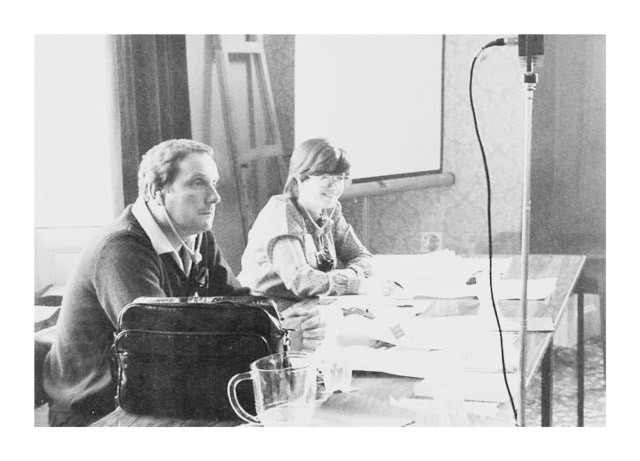
Nina Williams, at an early JCF trade union weekend seminar. Nina was then an Executive Member of the Civil & Public Services Association (CPSA). She was lecturer and tutor at this gathering.
Following her retirement, Nina became a trustee of the JCF. Andy Wood is also shown with Nina.
In 1984, the JCF was commissioned to organise a programme of training courses for the AEU. The series covered a
three-year period from November 1984 to September 1987, some were for full-time officers and others for shop stewards; each course was of 4-day duration."
The courses were organised by Paul Rathkey and Dave Bright, covering issues of the day: 'Employment Law', 'Company Information', 'Disclosure of Information', 'Company Accounts', Arbitration and the role of ACAS. All of the courses were held at Wortley Hall.

This image was taken at one of the AEU Wortley Hall courses. Paul Rathey is far left of the back row. Dave Bright is second from the left back row. It is one of the shop steward courses. Only one delegate can be positively identified. Tony Armstrong was a shop steward at NEI Parsons on Tyneside. He is fourth from the right back row.
Northern Ireland & ScotlandThe Foundation organised courses in Northern Ireland (NI) from 1985; The Troubles were very much in evidence for the time of JCF involvement, which was until 1998.
Andy Wood had operated in NI for the AEU before working with Jim Conway. During that time, he became well known to AEU officials and other agencies in Belfast.
Arising from that involvement, the JCF was asked to coordinate a series of three non-partisan seminars over an eighteen-month period. The series was successful and effected an annual gathering. All the Northern Ireland projects were held at the same venue, The Bohill Motor Inn in Coleraine.
Delegates were from both sides of the political/religious divide; not one problem arose from the issues associated with that discord.
Similarly, involvement in Scotland had been ongoing from the late 1970s, and an annual weekend event was held in Motherwell.
January 1997 was when the JCF held its 400th educational and training course. That landmark occasion took place at the Scarisbrook Hotel in Southport, Lancashire, and was a weekend seminar for affiliates and subscribers. The figure of 400 represented all educational and training exercises, including those yet to be mentioned concerning international education & training.
Approximately 80% of the organisational cost for each weekend course was covered by attendance fees. Fees paid by organisational affiliates reflected the total cost of each delegate attending the event, including a proportion of administration and staffing costs, with individual subscribers paying a reduced sum.
VenuesThe only references to UK venues on this site are to hotels; that was not typical. Over the years, various types of venues were used. The following are examples:
Stoke Rochford Hall is a Grade 1 Listed Mansion House. The National Union of Teachers acquired it in 1978 and used it as its training and conference centre. From 1979, the JCF utilised the conference facilities several times each year. Located just off the A1 in Lincolnshire and only six miles from Grantham railway station, it was ideally located.
Stoke Rochford Hall is currently a 71 guest-room private hotel.

This aerial view of Stoke Rochford Hall shows the rear of the property and a section of the extensive gardens. The Image is reproduced with the kind permission of the National Education Museum.
The National Water Sports Centre at Holme Pierrepont National Park in Nottingham was used many times, particularly in the early days. Courtesy of the late Jim Cattermole, East Midlands Regional Organiser of the Labour Party and a Nottinghamshire County Council (NCC) member, the NNC afforded the charity favourable conditions.
https://www.independent.co.uk/news/obituaries/jim-cattermole-6229108.html
Nottingham's central geographical location helped make the centre a popular venue.
A contemporary image of a seminar room at the National Water Sports Centre at Holme Pierrepont Park, Nottingham. Reproduced courtesy of the National Water Sports Centre
Gilsland Spa was owned by the Cooperative Wholesale Society (later the Cooperative Society) from 1901 to 2017. 'Gilsland', as it was affectionately known, was a popular venue. Its secluded location and convenient proximity—just off the A66—made it another preferred choice. It has 10 acres of land with extensive gardens and woodland.
The property is now a hotel with 93 guest rooms.

This image is the cover of a book relating to the history of Gilsland Spa during the 20th century (author Jim Lamb). Gilsland Spa was purchased by the Cooperative Wholesale Society (later the Cooperative Society, then Co-op) in 1901 to establish a convalescent home for its members in the north of England. During WWI, it was used as a military hospital and convalescent facility. During WWII, it became a maternity hospital for the duration of hostilities.
During the second half of the 20th century, ‘Gilsland’ had a multi-function purpose, mainly as a family holiday centre and was used for conferences by various organisations. The Co-op sold Gilsland Spa to a hotel group in 2017.
One other hotel should be mentioned, the Elstead Hotel at Bournemouth. The National Communications Union owned it until 1995, when it became the Communication Workers' Union, following amalgamation. It was a venue for several JCF weekend seminars and workshops during the 1990s.
Esher Place, Esher, Surrey - Esher Place was used several times between 1992 and 1998. Following several mergers, the AEU became the Amalgamated Engineering and Electrical Union; Esher Place became its education and conference centre. It now affords the same facilities for Unite the Union.
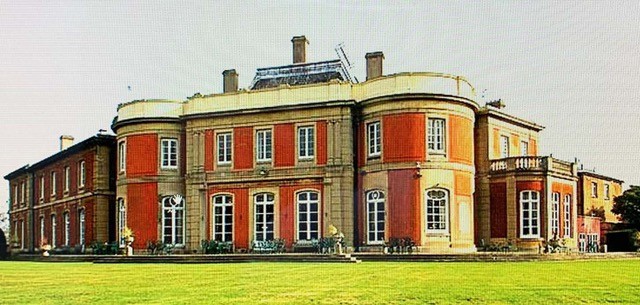
Esher Place
Joint Trade Union & Management TrainingThrough the AEU, and with the agreement of the East Midlands Engineering Employers' Federation (EMEEF), the JCF was invited to organise an exploratory conference at the EMEEF training centre in Rutland. An equal number of union and management representatives took part. Various unions participated; the occasion was considered successful, and the gathering became an annual event. The Rutland exercise led to similar conferences with the EMEEF regional equivalents based at Coventry and Newcastle.

This photograph was taken at the conference centre of the East Midlands Engineering Employers Association (EMEEA) in 1986. It was one of the joint Employer/Trade Union conferences referenced.
Left to right:
Dr David Bright (Lecturer in Industrial Relations & Business Studies at Durham University), Nigel Chubb (Director, EMEEF), Dr James McFarlane (Director, Engineering Employers Federation), Andy Wood (Director JCF), Bill Jordan (President AEU) and Paul Rathkey (Head of Research JCF).